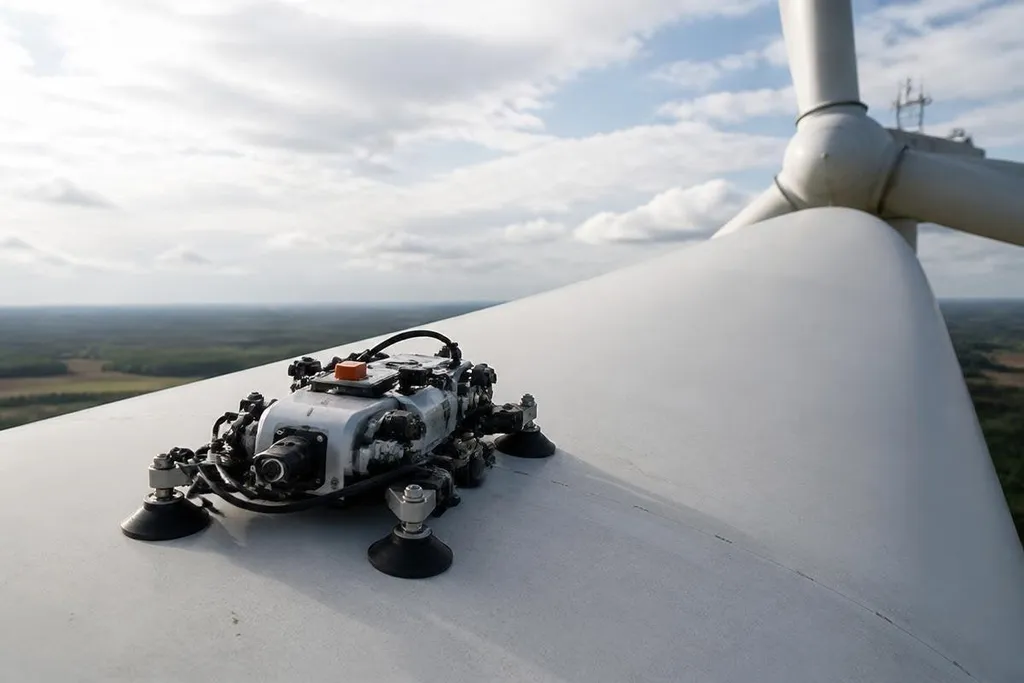
A blade-crawling robot moves across a wind-turbine blade while cameras and sensors look for damage. The idea could cut rope work and give maintenance teams a repeatable record, but the machine has to work on a curved composite surface high above the ground.
For now, the useful question is narrow: can the robot inspect enough of the blade, in real weather, with results a technician can act on?
- The robot needs a secure grip on a curved blade surface.
- Its images must show damage clearly enough for a technician to check.
- A trial should report the full route, missed areas, weather, and repair cost.
How the robot stays on the blade
A turbine blade is long, curved, and exposed to wind.
A crawling system may use wheels, tracks, suction, magnets, or a mechanical clamp, but each method has a limit. Magnets need a suitable metal surface, while suction can lose force when the surface is rough, wet, or dirty.
The machine also needs to cross changes in shape without slipping. That includes the blade edge, seams, surface patches, and areas where the curve changes. A system that works on a clean test panel has not yet shown that it can handle a working turbine blade.
A safety line may still be needed. If the robot falls, the team must keep it from hitting the tower, the ground, or another blade. The line can also add drag as the robot moves, so its weight, cable length, and attachment point belong in any test report.
What the robot must find
Inspection only matters when the output supports a decision. A camera can record a surface, but the result must help a technician tell a harmless mark from a crack, worn coating, or impact damage.
That makes lighting and image position important. The robot should record where each image came from, keep enough overlap between images, and show the blade section in a form that a person can check later. A clean picture with no location data leaves the repair team doing the same search again.
The system may also carry other sensors. Thermal cameras can show temperature differences, while ultrasonic tools can check material below the surface. Those methods answer different questions, so a trial should state which sensor found which type of defect rather than treating every image as equal proof.
A sensor result only matters if the robot can collect it safely on the blade. For engineers and maintenance managers, Robot 24 can connect the sensor, blade surface, test conditions, and human checks to the report. A service job adds movement, weather, access limits, and repair decisions that a controlled demo may leave out.
The gap between a demo and a service job
A short video can show that a robot climbs. It can't show how much of a blade the system covered, how often it stopped, or how a technician judged the report. Those details decide whether the machine replaces work or adds another review step.
The operator may also need to set up the robot, control its route, recover it after a fault, and move it between blades. Each task adds time. A useful trial will report the full inspection process, including setup and recovery, rather than showing only the smoothest run.
Weather matters too. Wind, rain, cold, heat, and surface dirt can change grip and image quality. A result from a sheltered test site says little about a turbine operating in open conditions unless the report describes those conditions.
The price question follows the same rule. A robot can cost less than a rope crew on paper and still lose that advantage through transport, supervision, batteries, data review, or a second inspection after poor images. No purchase case works without those costs.
A buyer's inspection checklist
Use these questions before treating a blade-crawling robot as ready for paid work:
- Surface range: Which blade coatings, curves, edges, and repair patches has the robot crossed?
- Defect proof: What damage can its sensors find, and who checked the results?
- Coverage record: Does the system show the route and identify missed sections?
- Weather limits: What wind, rain, temperature, and surface conditions were present?
- Recovery plan: How does the team retrieve the robot after a stop or loss of grip?
- Full cost: Does the quoted figure include setup, supervision, data review, and repeat visits?
What would count as progress
The next useful proof is a full blade inspection with a named operator, a recorded route, weather data, defect results, and a clear cost comparison. A demo can show movement; a service report has to show work that a maintenance team can use.
I'd wait for that report before treating blade-crawling robots as a replacement for established inspection crews. The machines may reduce time at height, but the open question is whether they can produce trusted findings across an entire working blade.